


In an age when almost everything seems to be produced on an industrial scale and shipped halfway around the world, it is quietly reassuring to discover that some things still belong firmly to the place that made them famous.

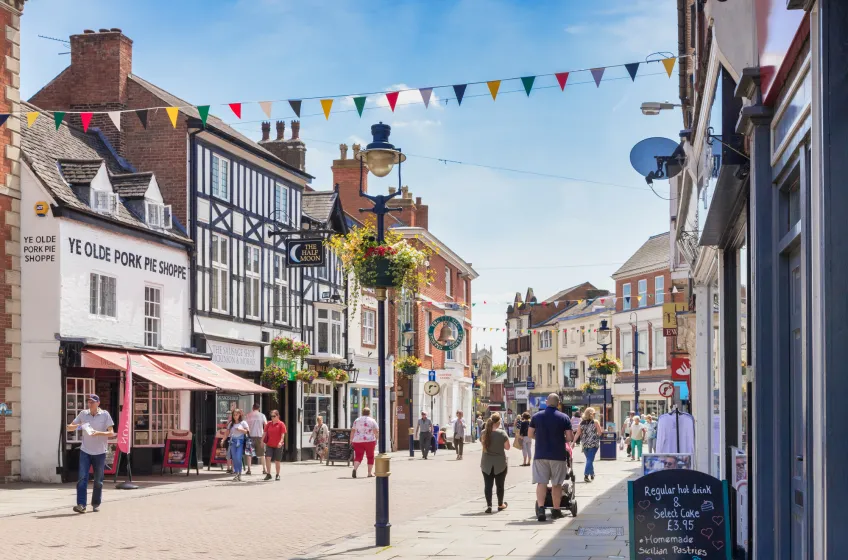

Few foods represent that idea better than the Melton Mowbray pork pie.
For generations, the town of Melton Mowbray in Leicestershire has been synonymous with this distinctive British delicacy: a hand-raised pastry crust, uncured pork filling, and a savoury jelly sealed neatly within. It is not merely a snack or picnic staple, but a product deeply tied to local tradition and craft.
Yet protecting that identity in the modern food industry has not been straightforward. During the late twentieth century, as mass production grew and supermarkets expanded their reach, the name “Melton Mowbray pork pie” risked becoming little more than a marketing phrase.
It was precisely this concern that led to the creation of the Melton Mowbray Pork Pie Association (MMPPA) in 1998 — an organisation formed to safeguard one of Britain’s most recognisable regional foods.
What followed was a decade-long effort involving European legislation, legal disputes, and a determined attempt by local producers to ensure that the Melton Mowbray pork pie remained exactly what it had always been: a product of place.
The creation of the Melton Mowbray Pork Pie Association
By the late 1990s, the pork pie industry around Melton Mowbray had begun to face a familiar challenge.
While traditional pies were still produced by local butchers and family businesses, large-scale manufacturers elsewhere in the country were also selling pies under the Melton Mowbray name, despite being made hundreds of miles away and often using different recipes.
To many local producers, this was more than a minor irritation.
The Melton Mowbray pork pie has a very particular identity. Its pastry is hand-raised rather than moulded, meaning the crust develops a distinctive irregular shape during baking. The meat inside is uncured, giving it a natural grey colour rather than the pink tone associated with mass-produced versions.
These characteristics were part of the pie’s heritage.
If the name could be used freely by any manufacturer, that heritage risked being diluted beyond recognition.
In response, a group of seven local manufacturers came together in 1998 to form the Melton Mowbray Pork Pie Association. Their goal was simple but ambitious: to protect the traditional recipe and ensure the name remained tied to the region that created it.
Seeking protection through European law
The association’s chosen route was the Protected Geographical Indication (PGI) scheme — a European system designed to protect regional foods with a strong link to a specific location.
The concept is familiar to anyone who has encountered products such as Parma ham or Champagne. These names are legally protected because their production methods and geographic origins are considered essential to their identity.
In 1999, the Melton Mowbray Pork Pie Association applied to the European Union to have the Melton Mowbray pork pie recognised under PGI status.
If successful, the designation would mean that only pies produced within a defined geographic area — and following the traditional method — could legally carry the Melton Mowbray name.
For the association’s members, it represented a vital safeguard.
For some large manufacturers, however, the proposal was far less welcome.
The dispute with Northern Foods
One of the most prominent opponents of the PGI application was Northern Foods, a major food corporation with substantial pork pie production operations.
Northern Foods argued that the proposed restrictions were unfair. The company had long used the Melton Mowbray name on its packaging despite producing pies outside the traditional area.
The dispute quickly became complex.
Northern Foods claimed that the geographical boundaries proposed by the association appeared to favour one of its dominant members, Samworth Brothers, whose factories fell within the designated region.
According to the corporation, this arrangement effectively allowed Samworth Brothers to continue producing pies under the protected name while restricting competitors elsewhere.
Northern Foods pointed out that Samworth had historically produced pork pies both within and outside the proposed region, including in Leicester. The company argued that shaping the designation area around those facilities raised questions about fairness.
At one point, Northern Foods claimed that approximately 99% of the pies produced under the association banner came from Samworth Brothers, further fuelling the controversy.
The dispute eventually escalated into legal proceedings.
Northern Foods challenged the PGI application through the courts, including an appeal to the European Court of Justice. Yet despite the legal pressure, the challenge ultimately faltered.
The company later withdrew its appeal, and earlier attempts to block the PGI designation were dismissed by the High Court.
Victory for the Melton Mowbray pork pie
After years of debate and legal argument, the application finally succeeded.
On 4 April 2008, the European Union formally granted Protected Geographical Indication status to the Melton Mowbray pork pie.
The protection came fully into force in July 2009.
From that point forward, only pies produced within the designated region — and made according to the traditional method — could legally use the Melton Mowbray name.
For the association and its members, the decision marked the culmination of a long campaign to preserve one of Britain’s most recognisable regional foods.
What defines a true Melton Mowbray pork pie?
The PGI designation did more than protect the name.
It also clearly defined what a genuine Melton Mowbray pork pie must be.
According to the official specification, authentic pies must meet several requirements.
1. The location
Production must take place within a defined geographic region surrounding Melton Mowbray.
This area is bounded by major roads including:
the M1
the A45
the A605
the A1
the A52
The region encompasses a broad area covering approximately 1,800 square miles, including towns such as Grantham, Northampton, Nottingham and Stamford.
2. The ingredients
The recipe is deliberately simple and traditional.
Permissible ingredients include:
fresh pork (at least 30% of the pie)
shortening, usually lard
pork gelatine or stock
wheat flour
water
salt
spices, primarily pepper
Crucially, the meat must be uncured, which is why authentic Melton Mowbray pork pies have a natural grey colour rather than the bright pink seen in many factory-produced pies.
Artificial colours, preservatives and flavourings are strictly prohibited.
3. The method
The pastry must be hand-raised and baked without supporting hoops or moulds.
This traditional technique gives the pie its distinctive shape, with slightly irregular sides rather than the perfectly uniform appearance associated with mass production.
The result is a pie that looks handmade — because it is.
Industrial change and the Bowyers factory closure
The introduction of PGI rules had significant implications for large-scale manufacturers.
Before the protection came into effect, Pork Farms, which had acquired Northern Foods’ pork pie interests, announced the closure of the Bowyers factory in Trowbridge, Wiltshire.
The decision resulted in the loss of approximately 400 jobs.
Production of the company’s pork pies — many of which had been marketed under the Melton Mowbray name — was transferred to Nottingham, which falls within the designated PGI area.
The move illustrated the real economic consequences of geographical food protections.
While the rules preserved the regional identity of the product, they also forced manufacturers to relocate production in order to continue using the protected name.
Protecting smaller producers
Supporters of the Melton Mowbray Pork Pie Association argue that the PGI designation ultimately benefits smaller producers.
Without protection, large food corporations could manufacture pies anywhere in the country and still market them under the Melton Mowbray name. That scenario would make it extremely difficult for independent butchers and family businesses to compete.
By restricting the name to pies made within the traditional region — and using the authentic method — the PGI system helps ensure that local producers retain a meaningful role in the market.
It also preserves the culinary traditions that give the product its reputation.
The association’s current members
Today, the Melton Mowbray Pork Pie Association represents a mixture of long-established butchers and specialist producers across the region.
Current members include:
Mrs King’s Pork Pies of Cotgrave
F Bailey & Son of Upper Broughton
Dickinson & Morris of Melton Mowbray
Brocklebys of Melton Mowbray
Mark Patrick Butchers of Birstall
Walker & Son of Beaumont Leys
Leesons Butchers of Oakham
Nelsons Family Butchers of Stamford
Dunkleys of Wellingborough
Hartland Pies of Cotgrave
Each of these businesses contributes to maintaining the traditional methods associated with the Melton Mowbray pork pie.
A regional food worth protecting
For those of us who grew up in the English countryside, foods like the Melton Mowbray pork pie represent something more than a convenient lunch.
They are part of a cultural landscape.
Regional foods connect people to place in ways that modern food production often struggles to replicate. They reflect the agricultural traditions, ingredients and craftsmanship of a particular area.
When those traditions are lost, something quietly important disappears with them.
The efforts of the Melton Mowbray Pork Pie Association demonstrate that protecting culinary heritage can be both practical and worthwhile.
After all, if one cannot rely on a proper Melton Mowbray pork pie being exactly what it claims to be, the modern world would feel rather poorer for it.
And that, surely, would be a great pity.
By James Blair




Write A Comment